Buying your first home is mostly a paperwork exercise with a site visit attached. The checks below are the ones that protect your money. Do the early ones yourself, and get a property lawyer to sign off on the title before you pay anything substantial.
Why the care? A DAKSH survey of Indian courts found that about two-thirds of civil cases in district courts relate to land and property. Most of those disputes start with a document someone didn't check.
1. Set the full budget — not just the price
The price on the brochure is not what you will pay. Add:
- Stamp duty and registration fee. In West Bengal these depend on the property's value and location. Use the official calculator on wbregistration.gov.in rather than a figure from a website.
- GST on flats bought while under construction. Completed flats with an occupancy certificate don't attract GST.
- Parking, club membership, legal and documentation charges, and advance maintenance collected at possession.
- Furnishing and moving costs.
Then decide your down payment. Banks usually lend 75–90% of the property's value, so plan to pay at least 10–25% yourself, plus all the costs above, from savings. Keep an emergency reserve of several months' EMIs on top. Be wary of "zero down payment" or "no EMI till possession" offers: read exactly who pays the interest, and what happens if the project is delayed.
2. Check the project on WBRERA
Every new project above a small size, and every agent, must be registered with the West Bengal Real Estate Regulatory Authority (WBRERA). Before you book:
- Search the project on rera.wb.gov.in and note its registration number.
- Check that the promoter's name, project name and phase match the brochure.
- Note the completion date declared to WBRERA — that, not the sales brochure, is the date the developer is accountable for.
- Look at the sanctioned plan and the number of floors and units approved.
- Check the developer's earlier projects: were they delivered on time, and are owners happy?
3. Check the title — registration alone isn't proof
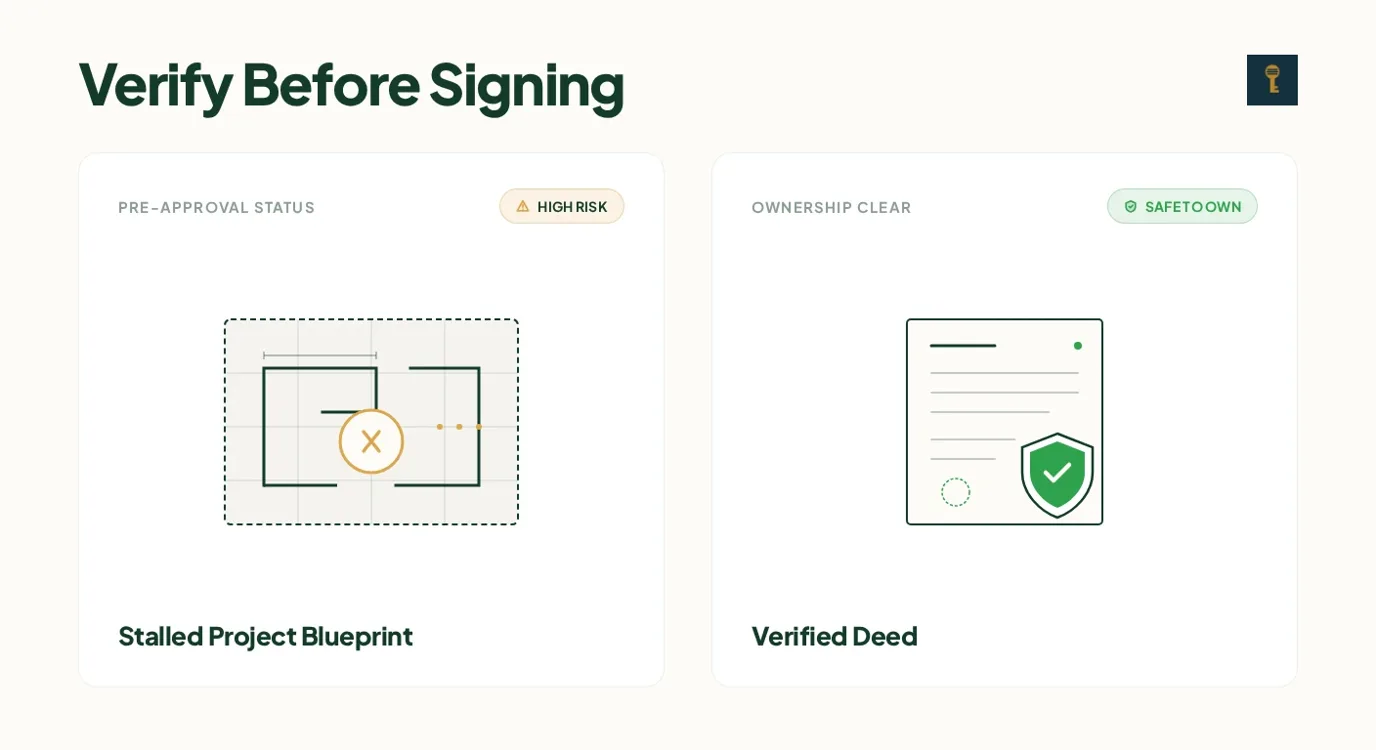
A registered sale deed proves that a document was executed and registered. It does not on its own prove that the seller had a clean right to sell. That is why a title search matters.
For a new project, your lawyer (or your bank's lawyer) should check the developer's title to the land and any development agreement with landowners. For a resale flat:
- Trace the chain of title deeds, commonly over the past 30 years.
- Get an encumbrance check — a search of registration records for mortgages or other claims.
- Confirm mutation: the seller's name should appear in the municipal property-tax records (KMC, NKDA or the local municipality) and, for land, in the state's land records.
- Confirm there are no unpaid property tax or society dues.
4. Read the agreement before paying more than 10%
Under RERA, a developer cannot take more than 10% of the price as an advance or application fee without first signing a registered agreement for sale with you. Before you sign, check:
- The flat number, carpet area, parking and what is included.
- The payment schedule — ideally linked to construction stages.
- The possession date and the compensation if it slips.
- Cancellation terms and how much you lose if you withdraw.
Never sign blank pages, and keep copies of every receipt.
5. Line up the loan early
Get your home loan sanctioned in principle before you book, so you know your real limit. For under-construction flats, the bank releases money in stages as work progresses; you pay interest on what has been released. Many banks have tie-ups with large projects, which can speed up approval — but compare at least two lenders' rates and fees.
6. Registration day
- Stamp duty is paid on the higher of your agreed price and the government's market value.
- Buyer, seller (or the developer's representative) and two witnesses attend the sub-registrar's office, with identity documents.
- Your bank will normally keep the original deed until the loan is repaid; keep certified copies.
7. Possession and after
- Inspect the flat before accepting possession and list every defect in writing.
- Ask for the completion or occupancy certificate.
- Under RERA, the developer must fix structural defects or poor workmanship reported within five years of possession, free of charge, within 30 days.
- Apply for mutation in your name, and transfer electricity and society membership.
The short version
| Before booking | Before the agreement | Before registration | At possession |
|---|---|---|---|
| Full budget and loan in principle | Lawyer's title report | Final cost sheet and stamp duty calculation | Inspection and defect list |
| WBRERA registration checked | Agreement read line by line | Loan disbursement arranged | Occupancy/completion certificate |
| Developer's record checked | No more than 10% paid | Identity documents ready | Mutation and utility transfers |
We help buyers compare projects across developers, arrange site visits and keep the paperwork moving. For the legal opinion itself, always use an independent property lawyer. If you'd like a second pair of eyes on a project you are considering, message us — we reply the same day.